Blog on the Lillypad
Friday, July 02, 2004
 | Adventures in Fitness
As the Lord works things out, I had just finished a vigorous workout at the gym and stopped by the Whole Foods store for some groceries. At the checkout line, the lady ahead of me got to chatting with me. She told me that she takes classes in a Hatha yoga style tat has benefited her. I admitted that my ongoing back problems have prompted many people to suggest yoga for me, but I am not enthusiastic. For one thing, while I disagree with much of Chinese and Japanese philosophical premises, I respect a lot of the writing and observations of Chinese and Japanese writers of bygone eras. |
But Indian philosophy leaves me cold. And the idea that enlightenment comes from attaining physical postures is impossible to me, and I can see how such ideas could easily be turned to great abuse of others.
On the practical side, even without the philosophy of yoga attached, the physical exercise of yoga strikes me as just too passive. (I'm sure some readers will see that I have been unfairly prejudiced on this point.)
But the woman in the checkout line, who is about ten years my senior and is a math teacher at UNC, told me that the class is physically demanding. And furthermore, the instructor is a woman of considerable expertise. And then she said the magic words, "It;s been a help to people who have had back trouble and shoulder trouble. You might want to try a class. It's only ten dollars."
No contract. I became a lot more interested. Her name is Sandy, and she went on to explain a lot more to me, which I will synopsize here.
Yoga is a very general term for a lot of different styles and philosophies that include the practice of physical postures to attain enlightenment. There's a huge diversity of disciplines that come under that big umbrella.
Hatha Yoga is a slightly more specific term that describes the purely physical side of yoga, detached from the philosophical/religious base. Under Hatha Yoga are several physical styles, including Bikrum and Vinyasa yoga, the newest forms to hit the American public. These are among the so-called "power yogas" that are now popular in small store-front franchises across the country.
| The class that I attended Thursday night is mostly Vinyasa yoga. It consists of several difficult (for me) postures that "open up" different joints, muscles, and organs. I was sweating within five minutes. Within ten minutes I was sweating so much that I was afraid I would slip on the mat. We did a lot of postures that either start or end with the person going into the pushup position but never touching down to the mat. We moved from one posture to the next, in a cycle, but a very slow cycle. |  |
The instructor, Vicky, who is also older than I and has the best posture I have ever seen on anybody, anywhere, ever, in my entire life, ran things with a gentle voice and clear instructions. I could see that in some ways she was surprised by what I could do on my first night. But given how strong I was with my legs, she was also surprised at what I could not do. I had warned her of my back trouble. So she occasionally tapped along my spine as I tried to maintain a pose, and she was startled at the degree of deformity in my back.
"Do you have any idea how high the right side of your mid back is standing up from the rest of it?" she asked. "Vicki," I gasped helplessly, "You're not helping!"
The truth is, years of punching, push-ups, and lifting weights postponed the inevitable for me. But now that the inevitable has come and I have back trouble, a good look at my back shows that where the spine is curved, one side of my back is highly developed, but the "stretched" side appears to have no muscle at all. So my rear deltoids, traps, and rhomboids on the left back and the lats and spinal erectors of my mid right back are muscular. But my right rear deltoids, traps, and rhomboids, and my mid left back have no definition at all. You cannot really see this when you look at me, but anybody who touches my back for a spinal exam or even a massage will notice the mis-matched sides.
 | There were a lot of postures I could not do, and she started me out on "junior" levels of these. One is called "the crow," in which the student gets on his or her hands and balances on them with the knees resting on the forearms. To my amazement, my fifty-something new friend, Sandy, could do this. She held it for a few seconds. I was impressed. Everybody else could do it and hold it at least for a second or two. They all agree that it's ab strength, way more than arm strength, that enables a person to do it. |
 | But the most amazing posture was what I call a "bridge." That's what martial artists call it, but yoga practitioners call it "Upward Facing Bow Pose". I watched my 50+ friend go into this pose and hold it with no apparent effort while I maintained what is considered an "easy" version of the pose, with my shoulders on the mat but my legs holding up my hips and lower back. "Don't worry," she told me. "I couldn't even hold the first level of this for months when I first started." |
Class lasted for an hour and fifty minutes, and sweat poured. But after the first thirty minutes I felt my back start to loosen. And to my surprise, the constant nausea that has plagued me for the last two weeks abruptly quit right at the end of class. I have chronic stomach trouble, so I just live with flare ups, but the yoga calmed it down. Hard martial arts practice used to do this too.
It was a welcome feeling to be covered with sweat again, to go home, plunge myself under the steaming jet of my shower, and then emerge, dry off, don clean pajamas, and eat a late supper, greatly relaxed and at peace with the world. It's been a long time since I have been able to work out for nearly two hours. And even though it wasn't the explosive type of taekwon do workout that I prefer, the results felt the same. I went to bed by ten and slept very deeply.
 | Gym Update
My newly gained liberation to return to the gym has become almost a mania to me, tempered only by the harsh experiences of having overtrained in the past to my own detriment. After a couple days of weightlifting and roadwork on the elliptical trainer, I met up with a man of incredible physique who gave me some help on back and ab exercises. As it turns out, he loves kickboxing, but he cannot keep hitting the bag for more than half a minute or so. |
Of course, if you're familiar with bagwork, you know that when you hit a heavy bag, most of the power that you slam into the bag will slam back into your arm. That's why powerful but untrained hitters (like my new gym pal), "punch out" after as few as eight or nine punches.
The strong guys slam that bag like Rocky, but they run out of energy fast. The stronger you are, the more force you've got pounding back into your muscles when you hit the bag. If your arm is isolated from your body (which happens if you lift your elbow high and to the side to punch the bag) then it is taking the full shock.
Think of it this way: a muscle-bound guy might deliver 300 foot pounds of force into the bag. Say 275 foot pounds of force come back. If he punches the bag ten times with the right arm, then within about 15 seconds the muscles of his arm and shoulder will have taken 2750 foot pounds of force. All in the bicep, tricep, and deltoids. Of course his arm will stop punching effectively. If he tries to keep going, the arm will simply quit as tonicity forces it to stop.
.JPG) | To hit a bag for a long, sustained period, you have to keep the elbows in, with the arms traveling on the centerline (or close to it), and punch with the entire body in proper alignment, from the feet up. And you have to relax through the punch until the last instant before impact. I explained this to him. To my surprise, he asked me to come the next day and instruct him. I agreed.
Men almost never ask a woman for help with punching, but this man is serious about wanting to do bag work. So we had a long session with the heavy bag in the aerobics room. |
We practiced the proper form, first through several one minute rounds on the bag, and then through several two minute rounds. When I was at my peak of fitness, I could hit the bag for eight-minute rounds, and I would do four to six eight-minute rounds with three minute rests between each set. It will take a lot of traning to get back to that level, but the successful tutoring session was a huge motivator for me. And it's nice to have made a friend at the gym.
Sunday, June 27, 2004
 | Back to the Gym
The last time I threw out my back was about January 19, 2004. It came after six weeks of Phase One weight lifting (four basic exercises per session). Perhaps because I had been strengthening my back, the most recent back crisis was not as severe as the previous three had been. But it was still the fourth time in a year and a half I had thrown it out. |
As before, I used the recovery time to experiment with more means of limiting inflammation in my back. Many people have their backs "go out," and yet they do not experience the radiating back pain that those of us with "bad backs" experience. I had been seeing a chiropractor for years, and once a chiropractor told me he didn't know why I wasn't experiencing pain in my right hip and right lower back. But I didn't develop painful back trouble until I was in my forties. Oh happy decade!
I had already experimented with fasting and had limited the back pain that way. This last time, instead of short interval fasting, I made a lifestyle change of eating fewer meals and drinking more fluids for calories and nutrients. Carrot juice became a mainstay, as well as soy milk.
I gave myself several months before going back to the gym. Once upon a time in my life, I would spend three hours in a gym four or five times a week. Now, I have two drawers in my spare room filled with unused gym clothes and pulse monitors, hand wraps, gloves, etc. I don't like to look at then because I miss my old life, but I know perfectly well that over training had a lot to do with some of my back trouble, and over training hinders recuperation tremendously.
But as the weeks went by and the back seemed to stabilize, I started to make plans to return by June 1. I went into Phase One again: a warm up of 15 minutes on an elliptical trainer, a lot of stretching, and four basic weight exercises that are easy on the back and yet strengthen it (roman chair, mid lat pulls, high lat pulls, and Smith Machine squats). I did this routine three times a week.
| And now, I've discovered a training aid that has made a huge difference in my back and its ability to handle a normal life: the exercise balls. Oh how I have come to love those exercise balls! Most people do crunches on them, but I lie on them and, with my feet on the floor, let myself roll back as far as I can go, stretching my back in an arch. It's incredible. I combine the exercise ball stretches with other stretches from my chiropractor, and at last it seems I have found the right mix. | 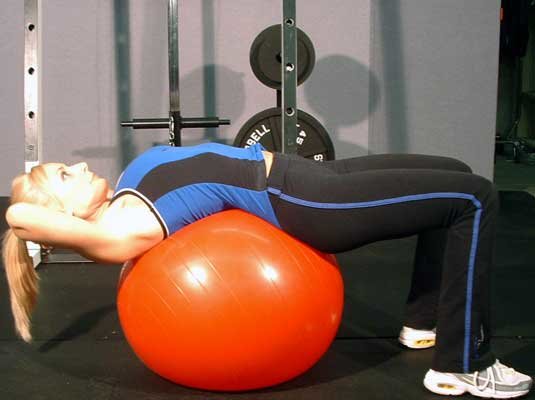 |
After four weeks on the Phase One program (three times a week), I have decided that I am now ready to increase to five exercises per session, and I plan to go into what is called a "two day split". That means on Day One, I exercise one or more muscle groups, and the next day, I exercise different muscle groups, then rest completely for a day, then repeat the two day split.
This past Saturday, I did five exercises (interspersing back stretches between each). I did lunges, which are incredibly difficult for me because my body is uneven in the way it supports itself (owing to the curve in my spine), Smith machine squats, chest presses, shoulder press, and rhomboid rows.
During the lunges, my left leg gave out on me, and I fell right over. I have always felt a certain stress in my left leg when I do lunges with the left leg forward. It's always been weak (though not this weak). I felt the muscles in the extreme right glute spasm in perfect time with part of my left quadricep, and then both abruptly stopped supporting me, and I fell over. I think that because of the "S" in my spine, the weight distribution is uneven. I don't hold myself up by equal effort of all muscles. And in certain stances, the stabilizers most crippled by the "S" become most stressed and then give out.
They can be built up. And certainly, as a woman approaching middle age, I need to build them up. In old age, a woman who has not built up her weakest stabilizing muscles will surely suffer falls and broken bones. I don't wish to be an invalid, and so strengthening is becoming a higher priority, passing the old goal of simply losing/controlling weight.
But the whole gym experience: feeling my body heat up and get looser, breaking into a sweat (which always feels purifying to me), leaving behind the cares of the day, and focusing on the quiet, austere challenge to lift the weight one more time with good form, all act like a rejuvenator to me. The stretches between each exercise slowly loosened my back and drew out the aches and stiffness. The gym I use has a quiet, focused clientele, many in middle age or older, with a diversity of Caucasion and African American patrons. A good gym is a classless society where everybody is polite, willing to lend a hand, able to advise, and yet mostly interested in minding his or her own business and doing what he or she has set out to do. It's humanity in harmony. After all, we all dress in rags, really. The days of spandex leotards are either over or are restricted to the pricier gyms. At Fitness and Beyond in Durham, shapeless cotton t-shirts and loose cotton shorts or trousers predominate.
Today, my quadriceps (the muscles in the front of your thighs) are raging, and my shoulders feel a littel tight. Tomorrow will be worse. It's like welcoming an old friend.
But Thursday, after a year of resisting the idea, I am scheduled to start a power yoga class with a semi-private instructor to work on strengthening "core" muscles that support the lower spine, and also loosen up the back. The instructor has gotten rave reviews, and her emphasis is the physical side of yoga. There's no philosophy attached except for a body conditioning philosophy that results are achieved by patience and consistency. Many martial artists resist the idea of yoga because its open passivity seems counter-productive to martial training. But students of this instructor report much better strength, as well as regaining flexibility and range of motion they thought they had lostyears ago. Hence, its appeal to me.
 | Moll Flanders
Written by Daniel Defoe, author of Robinson Crusoe, this book lacks its predecessor's suspense and wonder (for the modern reader, at least). Indeed, Moll Flanders is about a woman who had an affair before marriage in the hopes of catching a husband, was passed to his brother instead to wife, survived him to accidentally marry her own brother a few years later, escaped that unhappy union, gave herself over to being a mistress, married yet again and survived her husband, then became a thief and pickpocket (in a day when thieves were hanged), spent time in the hellish Newgate Prison, and then found her fortune in the colonies. |
You'd think a life like that could only hold reader interest. However, the style of the book manages to keep the modern reader a good distance away from the characters. Indeed, the characters are not characters at all in terms of reader expectations. They are but motionless figures in Moll's long, overly explained, colorless narrative. There is not one line of dialogue in the entire book.
Historically, the book is of interest because it marks the beginning of the novel. In Defoe's time (early seventeen hundreds), most "fiction" was actually in verse. Chaucer's bawdy Canterbury tales from several centuries before adorned many a book shelf of the learned, and the comparatively more recent Faerie Queen, with its higher and loftier purposes served as a sort of national epic. Smirkers could enjoy Hudibras, a lesser-known epic poem, whose illustrations survive today.
Prose tales tended to be moral stories. John Bunyon's earlier Pilgrim's Progress and The Holy War, were long allegories written to encourage reflection and thought. They figure as an apex of religious writing, but they are not quite the same thing as the English novel.
Otherwise, long narratives came from travelers, the wealthy, the powerful, and those who wished to inculcate ideas into simpler minds by means of telling their own true stories and moralizing upon them. Such stories were true accounts, replete with geographical details, commentary upon current political situations, and even lists of those in social prominence.
So the first novels imitated non-fiction. Swift's Gulliver's Travels purports to be the journal of Lemuel Gulliver, who shipwrecked in strange waters and discovered strange lands. Defoe's earlier work, Robinson Crusoe, was the fictionalized account of Andrew Selkirk, with much of Selkirk's spiritual journey removed from the narrative and replaced with sequences of danger and derring-do. Samuel Richardson's Pamela came to readers in the form of letters and diaries. The more entertaining Joseph Andrews by Henry Fielding started out as a semi-satirical true story about Pamela's brother.
Today, we read fiction as "live action" sequences. But then, fictional narrative was entirely retrospective. Dialogue, in the form that we read it, makes almost no appearance in the early novels. The careful insertion of a point-of-view character who does not know the end of the story any more than the reader does had not yet been developed. And the writers, perhaps to escape censorship, supplied their fiction with several layers of moralizing upon the good and evil encountered. Even Moll remains thoroughly repentant throughout the telling of her story. But her moralizing adds an insincere ring that becomes so detailed and tedious that it slows an already slow narrative.
I am told that PBS has broadcast a version of Moll Flanders much more appealing to readers. I can see that in screenplay, where dialogue must be supplied and where characters must become real, the story would engage the modern reader. But with so much left to the interpretation of the dramatist who renders it into script, you really have a story based on Moll Flanders, however well done, that is still not the book itself.
Nobody in my reading club found the book interesting as a novel. Indeed, only one person got all the way through it. But the concepts that emerge from the book, later to come to full flower under such great novelists like Charles Dickens, were worth discussing. We discussed the impact of the novel as a banned book, for Moll Flanders was censored in its day. But nobody could recall ever having heard of any modern controversies surrounding it. There is certainly no lurid detail in it and no foul language. Moll's sins are heavily distanced from the reader in her account. We supposed that the stupefying quality of the narrative was its own punishment for anybody who should try to plow through it in search of lascivious content.


